spirituality
Articles (1)
Authors (2)

Amit Goswami is a scientist and researcher who challenges mainstream scientific materialism, particularly in its application to consciousness, health, and healing. He advocates for the integration of spirituality with medicine and seeks to demonstrate the importance of consciousness in these areas—a view often dismissed by conventional scientific paradigms. Goswami draws heavily on the principles of quantum physics to argue for a reality where consciousness plays a fundamental role. He posits that the prevailing materialistic worldview, which treats the body and mind as mere machines, inhibits our understanding of health, healing, and the human experience. He believes that quantum physics offers an alternative perspective, one that acknowledges the subjective aspect of consciousness and its potential impact on our well-being. At a 2013 conference jointly organized by the Integrative Health Network and the Mormon Transhumanist Association, Goswami presented on “Quantum Physics, Consciousness and Health.” He emphasized the disconnect between the implications of quantum physics and its public perception, suggesting that media and academia have perpetuated materialistic concepts to the detriment of a more holistic understanding of consciousness and its potential for influencing health and personal agency. His work attempts to bridge the gap between scientific inquiry and spiritual understanding, encouraging a reevaluation of the role of consciousness in our lives.

Kathryn Knight Sonntag earned a BA in English and a BS in environmental studies before earning her MLA in landscape architecture and environmental planning. Her thesis focused on the role of the transcendent in landscapes and greatly informs her creative pursuits. She works as a freelance writer and landscape designer, and serves as the poetry editor for Wayfare Magazine. Her work centers on language as a powerful technology capable of manipulating ideas, transforming concepts, and achieving a specific vision. Sonntag’s scholarship builds upon ideas related to the role of language in shaping our understanding of the world and our relationship to it. Sonntag’s research delves into the archetype of the Divine Mother and the necessity of returning to her wisdom for the planet’s restoration. Drawing from thinkers like Elaine Showalter, Ursula K. Le Guin, and Jungian analyst Clarissa Pinkola Estés, she examines the suppressed experiences of women and the consequences of disconnecting from what she terms “wild nature.” Sonntag argues that a limited, male-centric view of nature has contributed to environmental degradation and that amplifying the voice of women is crucial for healing the world.
Quotations (1)
 Albert Einstein
Topical Guide (4)
Videos (11)
Chris Bradford
Open Thou Mine Eyes
Chris Bradford explores the tension between technological instrumentalism and genuine human relationship, drawing on Martin Buber’s distinction between “I-It” and “I-Thou” encounters. He argues that a purely technological approach to the world risks reducing people and nature to mere objects, and that Mormon transhumanism must complement its technological aspirations with the cultivation of empathy, charity, and recognition of the divine in others. Bradford contends that the grace saturating the world—visible when our “eyes are opened”—calls disciples of Christ to see and serve God in every neighbor, making the transhumanist project a fundamentally religious endeavor.
Ben Blair
Seek Ye First the Kingdom of God
Ben Blair argues that strong communities are byproducts of pursuing worthy aims rather than ends in themselves. He critiques both religious institutions that equate themselves with the kingdom of God and secular groups that make community their primary goal, suggesting that both miss the driving force of shared purpose. Drawing on examples from the D-Day invasion to the Mormon pioneers, Blair proposes that the Mormon Transhumanist Association’s aspirational vision—working collaboratively toward becoming gods who lift each other up—provides the kind of “work cut out for us” that sustains robust, long-lasting communities.
Chris Bradford
Transhumanism as Grace
Chris Bradford responds to Richard Bushman’s question about grace in transhumanism by proposing that divine grace is best understood as “givenness”—everything God has given us, in whom we “live, move, and have our being.” Drawing on Russian cosmist Nikolai Fedorov and Mormon scripture, he argues that God needs humanity to complete the divine work begun in creation. Bradford contends that all matter is infused with divinity, blurring the line between divine and human action, and that the transhumanist project—if infused with the spirit of Christ—can build a temple rather than another Tower of Babel.
Byron Belitsos
The Transhumans of Pre-history According to the Urantia Revelation
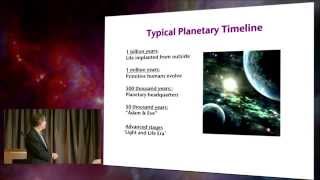
Byron Belitsos introduces the Urantia Revelation—a purportedly celestial text published in 1955—and explores its implications for transhumanist thought. He argues that the Urantia Book describes prehistoric genetic interventions by celestial beings, including a mission by Adam and Eve as biological “uplifters,” and contends that such transhumanist projects require spiritual depth and celestial oversight to succeed. Belitsos connects these ancient narratives to contemporary scientific findings, including genetic research suggesting a single-source introduction of brain-enhancing genes roughly 37,000 years ago, and calls for an “integrally informed” transhumanism grounded in spirituality rather than materialism.
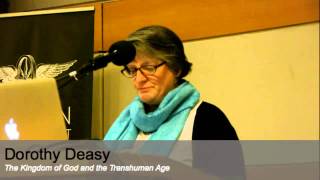
Dorothy Deasy
The Kingdom of God and the Transhuman Age
Dorothy Deasy argues that the perceived threats of transhumanism—often compared to Nazi eugenics—stem not from technology itself but from ideologies of total domination and the commercialization of humanity. Drawing on Hannah Arendt’s analysis of totalitarianism, she contends that spiritual transhumanism, grounded in nonviolence, human rights, and co-creation with God, can bring about the promises of the kingdom. Deasy calls for ecosystem and symbiotic thinking across all institutions, urging that transfiguration of society must be intentional and communal rather than individualistic.