faith
Articles (6)
New God Argument Version 4.0
The New God Argument v4.0 offers a logical case for faith in God rooted in science and technology trends—proving that trust in superhuman potential implies trust in God.
New God Argument Version 4.0
The New God Argument v4.0 offers a logical case for faith in God grounded in science and technology trends—proving that trust in superhuman potential implies trust in God.
Faith in the Future
Carl Youngblood presents 'Faith in the Future' at TransVision Abidjan 2025—a vision of pragmatic trust in our divine capacity to navigate great challenges.
Transhumanist Advent: On Dogma
Ben Blair challenges dogmatic thinking—religious or otherwise—in this Transhumanist Advent meditation on faith, doubt, and the open spirit of Jesus.
Human initiative and God’s desires
The brother of Jared's story models faith as active co-creation—God prefers human initiative over passive submission, aligning our will with divine purposes.
Quotations (16)

Topical Guide (7)
See all 7 resultsVideos (9)
Carl Youngblood
‘Help Thou Mine Unbelief’: Rescuing Faith in a Post-Secular Era
Carl Youngblood examines the crisis of faith in Mormonism’s post-secular era, where widespread access to information has made it difficult for the LDS Church to control its narrative. Drawing on Paul Tillich’s theology, he critiques common responses—apologetics, appeals to authority, fundamentalism, and secularism—as inadequate because they either mistake finite constructs for ultimate concern or abandon the symbols that give faith its vitality. Youngblood quotes B. H. Roberts’s call for “disciples of the second sort” who bring personal contributions to received truth rather than merely repeating formulas, and he positions the Mormon Transhumanist Association as cultivating such disciples.
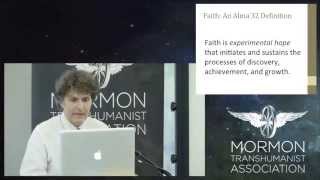
Don Bradley
An Experiment Upon the Word
Don Bradley analyzes Alma 32 as a post-biblical, post-Enlightenment reformulation of faith that draws on Jesus’s parables while transforming their meaning through scientific language. He argues that whereas the New Testament presents “taking no thought” favorably as trust in God’s providence, the Book of Mormon redeploys this phrase negatively—faith requires actively “arousing faculties” and conducting “experiments” rather than passive belief. Bradley identifies distinctly scientific vocabulary throughout Alma’s discourse (experiment, dormant, particle, discernible) and proposes a working definition: “faith is experimental hope that initiates and sustains the processes of discovery, achievement, and growth.” He suggests Latter-day Saints should learn to engage scripture through midrash—the Jewish tradition of creatively rewriting narratives to apply them to contemporary life.
You Are the New Day
The MTA Barbershop Chorus performs John Rutter’s “You Are the New Day,” a hymn of hope and renewal. Introduced by a reflection on humanity’s responsibility to shape the future through “good minds and loving hearts,” the performance celebrates themes of love, life, and the dawning possibility of each new day—affirming that hope persists even when time seems to be running out.
Jared Anderson
(De)Construction down the Rabbit Hole
Jared Anderson explores three approaches to faith crisis: apologetics, which defends inherited beliefs but leaves adherents vulnerable to new information; selective emphasis, which rebuilds meaning by highlighting a tradition’s most beneficial elements; and complete reconstruction through new myths and systems of meaning. Anderson argues that critical inquiry can only demolish worldviews—reconstruction is an art requiring theology, aesthetics, relationships, heritage, syncretism, and activism. He concludes that humanism and transhumanism offer frameworks for rebuilding when the “rabbit hole goes all the way down.”
Micah Redding
A Better Apocalypse: Ancient Eschatology for a Transhuman World
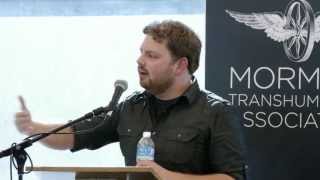
Micah Redding contrasts the failed end-of-world predictions exemplified by Harold Camping with the ancient Jewish prophetic tradition that viewed apocalypse not as history’s arbitrary termination but as moments when oppressive powers are overwhelmed by the rising tide of justice. He argues that this “better apocalypse” drew people more deeply into the world rather than out of it, inspiring figures like Martin Luther King Jr. to stand for truth even when victory seemed impossible. Redding suggests that spiritually oriented transhumanists can offer a similar forward-looking vision—one that calls humanity to courage and engagement rather than despair.