immortality
Articles (1)
Authors (1)

Woody Allen
Woody Allen (born 1935) is an American filmmaker, writer, actor, and comedian whose career spans more than six decades. Born Allan Stewart Konigsberg in Brooklyn, New York, he began his career as a comedy writer for television before transitioning to stand-up comedy and filmmaking. Allen’s films frequently explore themes of mortality, meaning, relationships, and the human condition, often with dark humor and philosophical undertones. His work has been influenced by existentialist philosophy, psychoanalysis, and the writings of authors like Dostoevsky and Kafka. Despite controversies in his personal life, Allen’s artistic output has earned numerous Academy Awards and international recognition. His reflections on death, immortality, and the search for meaning resonate with transhumanist concerns about human finitude and the desire for transcendence.
Quotations (8)
 David O. McKayDavid O. McKay
 Brigham Young
Topical Guide (3)
Videos (2)
Mike Perry
An Alternative to Quantum Archaeology in Resurrecting the Dead
Mike Perry, a longtime cryonicist and author of Forever for All, proposes “parallel recreation” as an alternative to quantum archaeology for resurrecting the dead. While quantum archaeology attempts to retrodict the exact positions of atoms throughout history—an approach Perry finds implausible given quantum uncertainty—his method accepts some loss of historical information while still achieving meaningful resurrection through “informed guesswork.” Drawing on multiverse theory and an informational view of reality where identical copies are distributed across infinite universes, Perry argues that recreating persons consistent with surviving historical records would yield authentic versions of those who once lived. He views cryonics as the preferable path, allowing one to be a benefactor in future resurrection efforts rather than merely a beneficiary.
Mike Perry
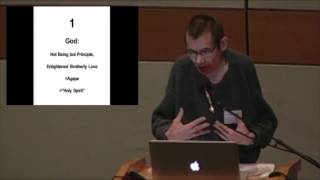
Christian Atheist Universal Immortalism
Mike Perry presents “Christian Atheist Universal Immortalism,” a philosophy combining the ethical framework of Christianity—enlightened brotherly love—with the belief that death can be overcome through scientific means rather than supernatural intervention. Perry argues that while Christian atheism provides a satisfying moral framework, it remains “deathist” in its acceptance of mortality; universal immortalism adds the commitment that all sentient beings should eventually gain salvation and eternal life through technological means such as cryonics. He views Jesus as a pioneer transhumanist immortalist whose command to “heal the sick and raise the dead” should be taken literally as our technology advances, and proposes that resurrection may be achieved through his “minibodies” theory rather than quantum archaeology, acknowledging that information may be irretrievably lost but that multiple authentic timelines could still be realized.