Nature and Consciousness
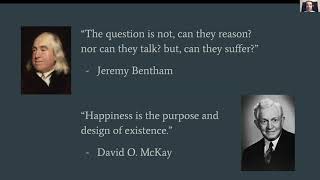
Jeremy Hadfield, a philosophy, neuroscience, and computer science student at Dartmouth and intern at the Qualia Research Institute, presents the symmetry theory of valence—a framework for quantifying happiness and suffering. He proposes that mental states feel good or bad based on the symmetry of brain processes: consonant, symmetrical neural oscillations correlate with positive experiences, while dissonant patterns correlate with suffering. Using connectome-specific harmonic waves—mathematical tools borrowed from acoustics and applied to brain imaging—researchers can measure these patterns and potentially test the theory. Hadfield explores applications including understanding why meditation increases well-being, why exposure to nature improves mood, and how this framework might eventually allow us to communicate what “good” and “bad” mean to artificial intelligence in precise, measurable terms.