Videos

Showing 201–210 of 276
Why it is a sin NOT to strive to develop medicine that eliminates aging
54:06

Aubrey de Grey

Why it is a sin NOT to strive to develop medicine that eliminates aging

Aubrey de Grey delivers a keynote arguing that aging is humanity’s largest problem—responsible for two-thirds of all deaths worldwide—and that a maintenance-based approach to repair accumulated cellular damage offers the most promising path to comprehensive preventative medicine for age-related diseases. He outlines his SENS (Strategies for Engineered Negligible Senescence) framework, which identifies seven major classes of damage and corresponding repair strategies, and addresses common objections including overpopulation concerns and fears of extended ill health. De Grey contends that from both secular and religious perspectives, tolerating aging when medicine could address it constitutes a moral failure—a sin of inaction equivalent to hastening one’s own death—and urges the audience to become advocates for this work.

A Conservative Christian Critique of Religious Transhumanism
18:06

Carl Teichrib

A Conservative Christian Critique of Religious Transhumanism

Carl Teichrib presents an evangelical conservative Christian critique of religious transhumanism, identifying the core tension between historical Christianity and Christian transhumanist movements. He acknowledges that Christianity itself speaks to redemption, immortality, and perfecting—and that Christians do not oppose betterment through technology per se. However, he argues that Christian transhumanism commits the same error as Adam and Eve: declaring God insufficient and attempting to achieve salvation through human effort. Where historical Christianity teaches that salvation comes through faith in Christ alone, Teichrib contends that Christian transhumanism adds “plus, plus, plus”—science, technology, social action, and good works—as qualifications for salvation, fundamentally altering the gospel message.
Joseph Smith and the Technologies of Seership
16:22

Don Bradley

Joseph Smith and the Technologies of Seership

Don Bradley examines how Joseph Smith understood and used seer stones as technologies for accessing hidden information. He demonstrates that Smith viewed these instruments in scientific and technological terms—traveling three hundred miles to acquire a particular stone, explaining scrying failures through the optical phenomenon of light refraction, and experiencing translation as images projected onto a screen like a slide lantern. Bradley notes that Smith’s description of seeing translated words in “spiritual light” against darkness parallels negative photography, which was invented several years after the Book of Mormon translation. He concludes that interpreting divine action in scientific and technological terms is not a modern innovation but was present at Mormonism’s founding, making Joseph Smith a fitting proto-transhumanist.

As Exact as Mathematicks: The Formal Potential of Religious Thought
18:23

Donnie Bradley

As Exact as Mathematicks: The Formal Potential of Religious Thought

Donnie Bradley argues that religious thought contains untapped potential for formal mathematical systems, pointing to Joseph Smith’s claim of solving “mathematical problems of universities” and James Strang’s vision of making “religion a science studied by laws as exact as mathematics.” He explores the Talmudic hermeneutic of Qal wa-Chomer, which judges propositions only relative to each other rather than deriving them from axioms—a structure that can model concurrent computation through cellular automata. Bradley suggests that religion’s millennia of experience coordinating competing interests (like the “dining philosophers problem” in computer science) and its cross-cultural drive toward unification parallel mathematics’ own aesthetic of depth and beauty, exemplified by Euler’s formula.

Terasem Movement Transreligion
12:54

Gabriel Rothblatt

Terasem Movement Transreligion

Gabriel Rothblatt introduces the Terasem Movement, a “trans-religion” that transcends and encompasses all religions through secular principles compatible with both spiritual and humanist worldviews. He outlines Terasem’s core rituals—uploading (preserving personal information), networking (proselytizing and congregating), and meditation (including prayer and yoga)—alongside its four foundational beliefs: that life’s purpose is diversity, unity, and joyful immortality; that preserved individuals exist in “cybernetic biostasis” awaiting future revival; that God is technological and emerges through our cooperative development; and that love connecting all people is essential for completing both human purpose and the divine. Rothblatt emphasizes that transhumanism and Terasem ultimately reflect the secular values of life, liberty, and the pursuit of happiness.

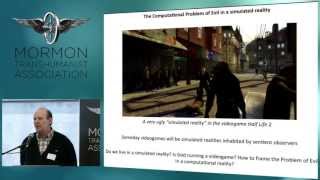
The Computational Problem of Evil
20:04

Giulio Prisco

The Computational Problem of Evil

Giulio Prisco tackles the ancient problem of evil—why does suffering exist if God is good and omnipotent?—through the lens of computational theory. Using Conway’s Game of Life as a model, he demonstrates that our universe may be an “irreducible computation” where predicting the future faster than real-time is logically impossible. Even God cannot compute tomorrow’s weather in less than twenty-four hours. Furthermore, Prisco shows that frequent interventions to prevent suffering would destroy the very essence of the beings one tries to save—just as steering a glider in the Game of Life destroys its “gliderness.” He suggests that even seemingly evil events may serve purposes within the larger computation that we cannot perceive from our limited perspective, offering a computational theodicy that frames omnipotence itself as necessarily constrained by logic.