Videos

Showing 191–200 of 276
Atheists & Mormons: Exposing Myths, Dispelling Stereotypes
1:25:51

David Silverman

Atheists & Mormons: Exposing Myths, Dispelling Stereotypes

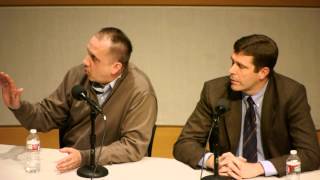
This panel discussion, moderated by historian Paul Reeve and sponsored by the Mormon Transhumanist Association, brings together atheist leaders David Silverman and Joanne Hanks with BYU professors Richard Holzapfel and J.B. Haws to explore mutual misperceptions between Mormons and atheists. The conversation addresses stereotypes on both sides—including Mormon exclusivity and atheist immorality—while examining topics like baptism for the dead, church transparency about history, and whether religious belief constitutes “brainwashing” or represents a legitimate choice based on personal experience. The panelists ultimately find common ground in valuing charitable giving and civil dialogue, while disagreeing fundamentally about whether religious belief is intellectually honest and whether religion will persist or eventually disappear.

Amit Goswami on Quantum Physics, Consciousness and Health
1:22:06

Amit Goswami

Amit Goswami on Quantum Physics, Consciousness and Health

Amit Goswami argues that quantum physics reveals a reality beyond space-time—a domain of potentiality from which consciousness chooses what becomes actual. He presents experimental evidence for nonlocal communication between correlated minds, showing that intention and meditation can produce measurable brain activity in distant subjects. Goswami applies these principles to health and healing, proposing that blocked emotions—particularly suppressed love associated with the heart chakra—can impair immune function and contribute to diseases like breast cancer. He advocates for a science that treats humans not as machines but as conscious beings capable of participating in their own healing through quantum leaps of insight and transformation.

Religion as Social Technology
20:22

Carl Youngblood

Religion as Social Technology

The speaker examines the secularization thesis—the idea that scientific progress leads to religion’s decline—and finds it showing signs of age. Drawing on sociologist Robert Bellah’s work, he argues that religion, broadly defined as symbol systems that establish powerful moods and motivations, is deeply embedded in human evolutionary development and is not going away. He observes that secular narratives like environmentalism often take on religious functions, complete with concepts of original sin, redemption, and apocalypse. Scientists frequently cross into religious territory when making cosmic claims about humanity’s place in the universe, whether optimistic (like Carl Sagan’s “we are star stuff”) or pessimistic. The speaker concludes that religion is essentially a social technology—one that can be used for good or ill—and urges greater awareness of when we cross into religious territory in our discourse.