Videos

Showing 181–190 of 276
What is the Pace of Technological Change?
25:41

James Carroll

What is the Pace of Technological Change?

James Carroll examines the critical debate between linear and exponential technological growth, a question central to transhumanist predictions about the future. He presents arguments from both sides: linearists point to slowing “life impact” of new inventions compared to transformative technologies like indoor plumbing, while exponentialists cite Moore’s Law and the combinatorics of technological innovation. Carroll analyzes data on microprocessor speeds, gene sequencing costs, and supercomputer performance, finding mixed evidence. His key conclusion: regardless of what happens after Moore’s Law ends around 2025, computing hardware will likely reach human-brain simulation capacity before that deadline—making AI development’s trajectory dependent primarily on software advances rather than hardware limitations.

Authentic Mormonism and Motivation to Action
19:28

Joseph West

Authentic Mormonism and Motivation to Action

Joseph West examines how shame and pride surrounding Mormon history shape Latter-day Saint identity and collective action, drawing on Kathleen Flake’s scholarship about the church’s turn-of-the-century transformation following the abandonment of polygamy. He argues that when faced with the Reed Smoot hearings, church leadership chose assimilation over resistance—publicly distancing from earlier practices and shifting the source of legitimacy from distinctive economic and family arrangements to the First Vision and continuing revelation. West suggests that this repression foreclosed the possibility of redeeming the “sins of polygamy” through internal reform, and uses the metaphor of the Salt Lake Temple’s buried sandstone foundation—later replaced with granite—to suggest that contemporary movements like the Mormon Transhumanist Association may be uncovering and rebuilding Mormon identity on stronger foundations.

Analysis, Loss of Meaning, and Religious Transhumanism
12:09

Micah Redding

Analysis, Loss of Meaning, and Religious Transhumanism

Micah Redding explores how analytical thinking, while essential for progress, can dismantle the systems of meaning that give our lives coherence—much like dissecting a frog leaves something missing even when all the pieces remain. He argues that religious transhumanists often excel at analysis but struggle with the complementary task of building new meaning, leading to a sense of loss even among those who successfully reconstruct their worldviews. Redding proposes that the solution lies not in abandoning rationality but in becoming better storytellers, recognizing that religious transhumanism offers a uniquely powerful narrative—one that unites ancient questions with modern ambitions into a single story about what it means to be human.

The Religious Brain Project
15:56

Michael Ferguson

The Religious Brain Project

Michael Ferguson introduces the Religious Brain Project, a collaborative research initiative at the University of Utah using functional MRI to study Mormon spirituality. He traces the philosophical history from Descartes’ dualism through Joseph Smith’s “queering” of the material-spiritual binary, positioning the project within William James’s pragmatist tradition of assessing religion by its fruits. Ferguson describes the study’s methodology—behavioral questionnaires measuring religiosity, empathy, and moral cognition alongside neuroimaging of participants watching General Conference, praying, and pressing a button when they “feel the Spirit”—aiming to map the neural correlates of Mormon spiritual experience and explore questions of neuroplasticity, such as how missionary service might reshape brain connectivity.

Where Is Heaven? Examination of Multiple-World Models of the Cosmos and Beyond
22:40

Michael LaTorra

Where Is Heaven? Examination of Multiple-World Models of the Cosmos and Beyond

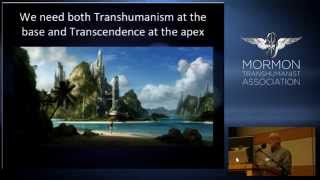
Michael LaTorra distinguishes between “paradise”—a really nice place achievable through transhumanist technologies—and “heaven,” the ultimate place reachable only through spiritual transcendence. Drawing on Buddhist cosmology’s thirty-one planes of existence and Avatar Adi Da Samraj’s teaching of seven stages of life, he presents a cosmic mandala where progressively subtler realms of experience exist beyond our gross material world. Even the highest astral and subtle planes, filled with bliss and joy, remain impermanent and conditioned; true heaven or nirvana transcends all cosmic planes entirely. LaTorra shares first-hand accounts from spiritual practitioners who have glimpsed these higher realms, and concludes that humanity needs both: transhumanism at the base to improve earthly existence, and spiritual transcendence at the apex for ultimate realization.

Thoughts on Transhumanism and Religion
49:53

Natasha Vita-More

Thoughts on Transhumanism and Religion

Natasha Vita-More, a pioneer of transhumanist thought and designer of the Primo Posthuman future body prototype, shares her personal journey from artist to theorist to life extension researcher. She emphasizes the importance of individual stories and first-hand experience over collective assumptions, describing how her near-fatal pregnancy loss in Japan drove her to design solutions for human vulnerability and mortality. Vita-More discusses her current research at Alcor vitrifying C. elegans worms to test memory retention after cryonic preservation—work that could have profound implications for life extension. Throughout, she advocates for building new narratives that bridge transhumanism with religious and spiritual perspectives through shared aesthetics, ritual, and mutual appreciation rather than dictated beliefs.