Videos

Showing 161–170 of 276
Roman Catholicism and Transhumanism
33:54

Brian Green

Roman Catholicism and Transhumanism

Brian Green of Santa Clara University examines the relationship between Roman Catholicism and transhumanism, dispelling common myths while identifying genuine points of tension. He demonstrates that the Catholic Church is one of the world’s largest healthcare providers and has no intrinsic objection to genetic enhancement or life extension—challenging assumptions that Christianity inherently opposes transhumanist goals. Green identifies real tensions including the improbability of material immortality, justice concerns about access and inequality, the conceptual impossibility of human omnipotence (for which he proposes the term “anthropotence”), and the dangers of pursuing utopia. He concludes that if transhumanists seek to become like gods, they would benefit from engaging with theologians who have studied divine attributes for millennia.

The Transhumans of Pre-history According to the Urantia Revelation
38:50

Byron Belitsos

The Transhumans of Pre-history According to the Urantia Revelation

Byron Belitsos introduces the Urantia Revelation—a purportedly celestial text published in 1955—and explores its implications for transhumanist thought. He argues that the Urantia Book describes prehistoric genetic interventions by celestial beings, including a mission by Adam and Eve as biological “uplifters,” and contends that such transhumanist projects require spiritual depth and celestial oversight to succeed. Belitsos connects these ancient narratives to contemporary scientific findings, including genetic research suggesting a single-source introduction of brain-enhancing genes roughly 37,000 years ago, and calls for an “integrally informed” transhumanism grounded in spirituality rather than materialism.

Raelism: When Atheism and Intelligent Design are One
24:47

Felix Clairvoyant

Raelism: When Atheism and Intelligent Design are One

Felix Clairvoyant presents the Raelian movement’s unique synthesis of atheism and intelligent design, explaining how its founder, Rael, claims to have received a message from extraterrestrial scientists called the Elohim who engineered all life on Earth through DNA and genetic technology. Unlike traditional creationism, Raelian intelligent design posits plural designers—a diverse team of scientists and artists representing both genders and all races—rather than a singular mystical God. Clairvoyant emphasizes that the movement is entirely pro-science, viewing emerging technologies as pathways to scientific immortality and human flourishing, while advocating for love, consciousness, and world peace as prerequisites for the Elohim’s eventual return.

Daily Transhumanist Spirituality
10:20

Jason Xu

Daily Transhumanist Spirituality

Jason Xu describes his journey to find daily spiritual practice aligned with transhumanist values, ultimately discovering Terasem—an organization whose four principles (life is purposeful, death is optional, God is technological, love is essential) resonated with his beliefs. Frustrated by the lack of transhumanist rituals comparable to traditional religious practices, Xu had previously attended Christian, Muslim, and Hare Krishna services while interpreting their teachings through a transhumanist lens. He advocates for transhumanism as a grand metanarrative that can provide meaning, arguing that strong AI and mind uploading will eventually offer a form of salvation, and that future religions will increasingly incorporate transhumanist themes as technology advances toward the singularity.
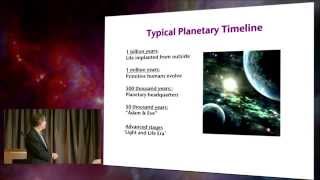
Where is Heaven?
41:03

Where is Heaven?

Mike LaTorra presents a Buddhist-transhumanist framework for understanding the cosmos and human spiritual potential. He distinguishes between “paradise”—progressively better states achievable through transhumanist means—and “heaven”—an ultimate transcendent reality that lies beyond all conditioned existence. Drawing on Buddhist cosmology’s 31 planes of existence and Avatar Adi Da Samraj’s seven stages of life, LaTorra argues that while science and technology can create improved circumstances for human flourishing, the ultimate goal of awakening requires spiritual practice. He proposes that transhumanism and transcendence work together: a transhumanist world with extended lifespans and material abundance would actually facilitate Buddhist practice by removing obstacles that currently interfere with meditation and retreat.

How to Change the World: From Self Improvement to Transhumanist Movement Creation
26:16

Shannon Avana

How to Change the World: From Self Improvement to Transhumanist Movement Creation

Shannon Avana shares her personal journey from confident atheism through agnosticism to theism, using it as a lens to explore how beliefs shape reality. She demonstrates through research on optimism and her own coaching practice that one’s point of view functions as a self-fulfilling prophecy—what we focus on, we nurture and create more of. Avana challenges transhumanists to consider whether focusing on differences and judgments or on shared goals of improving the human experience will better serve the movement. She concludes that meaningful change requires choosing a unified focus, suggesting that the voices in our heads are not divine commands but choices we can redirect toward what truly matters.