Videos

Showing 151–160 of 276
Myths and Visions of Mormon Transhumanists
20:55

Lincoln Cannon

Myths and Visions of Mormon Transhumanists

Lincoln Cannon, president of the Mormon Transhumanist Association, opens the 2015 conference by addressing the challenges facing both traditional religions and secular transhumanism in rapidly changing times. He presents a series of speculative narratives tracing humanity’s potential technological and spiritual evolution—from biotech and nanotech revolutions to eventual transfiguration and resurrection—framing these as modern expressions of ancient prophetic traditions. Cannon argues that Mormon transhumanism represents humanity’s calling to learn how to become gods, not through hubris but through compassionate creation, and invites the audience to engage in the communal work of prophecy that steers humanity toward opportunity rather than risk.

The Urgent Need for Christian Transhumanism
10:38

Micah Redding

The Urgent Need for Christian Transhumanism

The speaker contrasts “horizontal progress”—spreading current technologies and lifestyles globally—with “vertical progress,” the creation of genuinely new solutions through human creativity and innovation. Drawing on Peter Thiel’s work, he argues that horizontal progress alone is unsustainable and that humanity needs orders of magnitude more people engaged in the kind of long-term, creative thinking that transhumanism represents. However, he observes that transhumanism faces a perception problem: some view it as wanting to eradicate humanity. Meanwhile, Christianity faces its own challenge of potentially becoming reactionary rather than engaging with scientific and technological change. Christian transhumanism, he proposes, can bridge these worlds—helping two billion Christians engage with the serious challenges of the next century while grounding transhumanism in an appreciation for the full breadth and depth of human life.

Social Mind Upload: Unleashing our Empathy
16:33

Michaelann Gardner

Social Mind Upload: Unleashing our Empathy

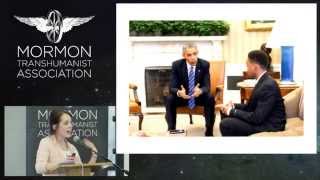
Michaelann Gardner argues that social media functions as a kind of “social mind upload” that can help address three transhumanist fears: perfecting the human race at the expense of individuals, technology disconnecting us from our humanity, and advanced technology benefiting only the wealthy. Drawing on research about empathy—how reading novels activates emotional intelligence, how images of suffering stimulate the vagus nerve, and how living in diverse communities increases generosity—she demonstrates that social media mirrors all three empathy-building mechanisms. Using the viral story of Vidal, a young boy from a struggling New York school whose community raised $1.4 million through crowdfunding, Gardner illustrates how these platforms can break down social barriers, connect strangers around shared causes, and help “turn the ship of technology” toward the good.

Ask Siri: A Glimpse of Tomorrow’s Technological Government
16:25

Rachel Stone

Ask Siri: A Glimpse of Tomorrow’s Technological Government

Rachel Stone, a BYU student studying the intersection of technology and government, imagines a future government-issued AI assistant named Siri that could transform civic engagement. Drawing on examples from Estonia’s e-voting experiments and various crowdsourcing platforms, she explores how technology could enable personalized government services, streamlined citizen feedback, and direct digital democracy. Stone discusses platforms like Democracy OS and Pop Vox that let citizens propose amendments and vote on bills, while acknowledging the privacy challenges of online voting. She concludes by envisioning AI systems that could weigh policy arguments and help overcome the “bounded rationality” that limits human decision-making.

Panel discussion with Ralph Merkle, Kristine Haglund and Lincoln Cannon
34:29

Ralph Merkle

Panel discussion with Ralph Merkle, Kristine Haglund and Lincoln Cannon

In this panel discussion, Ralph Merkle, Kristine Haglund, and Lincoln Cannon field audience questions on topics ranging from cryptocurrency and governance to theodicy and the nature of God. Merkle discusses the potential of Bitcoin’s distributed algorithm for governance and the challenge of achieving stable government over transhumanist timescales. Haglund shares her “personal heresy” that God may not have complete foreknowledge, likening divine knowledge to a “choose your own adventure” book. Cannon offers a Mormon transhumanist interpretation of the Holy Spirit as the sublime aesthetic embedded in creation that provokes us toward compassion and creativity—the grace of possibility pushing us to become gods ourselves.

Mormon Transhumanism
35:41

Lincoln Cannon

Mormon Transhumanism

Lincoln Cannon introduces Mormon transhumanism to a secular audience, explaining how Mormonism’s unusual metaphysics—an embodied God, uncreated matter, and humanity’s divine potential—make it uniquely compatible with transhumanist aspirations. He presents the “New God Argument,” which reasons that if humanity survives to become a superintelligent posthumanity, we would likely be both more compassionate than we are now and capable of creating worlds, suggesting we probably already live in a created world governed by benevolent superintelligence. Cannon describes the Mormon Transhumanist Association’s work to synthesize religious and technological visions, noting that Mormons’ scriptural mandate to pursue godhood through transformation may provide legal grounds for advancing enhanced intelligence research under religious freedom protections.