Videos

Showing 141–150 of 276
Mormonism and the Fractal Lineage of Gods
20:23

Caleb Jones

Mormonism and the Fractal Lineage of Gods

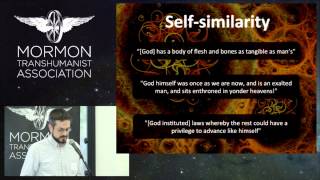
Caleb Jones presents Mormon theology through the lens of fractal geometry, proposing that the relationship between humanity and God can be understood as a fractal progression. Drawing on Joseph Smith’s teachings about the eternal nature of intelligence and Lorenzo Snow’s couplet—“As man now is, God once was; as God is now, man may be”—Jones argues that Mormonism’s ontology exhibits key fractal properties: self-similarity between humans and God, continuous line-upon-line progress, recursive self-referential laws, and infinite aesthetic variety. He suggests that fractal mathematics, pioneered by Benoit Mandelbrot, provides a richer symbolic framework than Joseph Smith’s original ring metaphor for understanding eternal progression, the temple ritual’s transgenerational symbolism, and the simulation hypothesis’s intersection with Mormon cosmology.
The Challenges and Opportunities of Religious Transhumanism
13:17

Carl Youngblood

The Challenges and Opportunities of Religious Transhumanism

Carl Youngblood addresses the challenges and opportunities facing religious transhumanists, who often find themselves caught between secular technologists who dismiss religion and religious communities suspicious of their framing. He argues that both camps need each other: Mormonism offers transhumanism a respectful attitude toward tradition, exceptional organizational capacity, and a theology remarkably compatible with naturalism—including the belief that all phenomena, even miracles, must have natural explanations. Conversely, transhumanism challenges religion to move beyond distant, comfortable redemption narratives. Responding to concerns that mere immortality would only amplify human brokenness, Youngblood distinguishes between overcoming death and achieving “eternal life”—a state of godlike compassion that Mormon transhumanists pursue using every tool at their disposal, including science and technology.

Divine Aspirations: Creation, Ritual, and Authority
18:12

Chris Bradford

Divine Aspirations: Creation, Ritual, and Authority

This presentation critiques the standard top-down model of divine authority in Mormonism—where God delegates power downward and refuses to recognize unauthorized rituals—and proposes an alternative bottom-up model rooted in Mormon scripture. Drawing on Doctrine and Covenants 29 and 121, the speaker argues that God’s power derives from honor freely given by those who trust in divine love, not from coercive imposition. Using analogies from computer science, including certificate authorities and distributed systems, the talk reframes authority as emerging from community consent and ritual as aspirational rather than mechanically efficacious—a projection of faith toward a future divine community that will ultimately validate the covenants made in hope.

An Experiment Upon the Word
20:13

Don Bradley

An Experiment Upon the Word

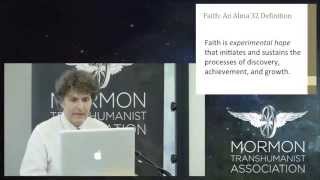
Don Bradley analyzes Alma 32 as a post-biblical, post-Enlightenment reformulation of faith that draws on Jesus’s parables while transforming their meaning through scientific language. He argues that whereas the New Testament presents “taking no thought” favorably as trust in God’s providence, the Book of Mormon redeploys this phrase negatively—faith requires actively “arousing faculties” and conducting “experiments” rather than passive belief. Bradley identifies distinctly scientific vocabulary throughout Alma’s discourse (experiment, dormant, particle, discernible) and proposes a working definition: “faith is experimental hope that initiates and sustains the processes of discovery, achievement, and growth.” He suggests Latter-day Saints should learn to engage scripture through midrash—the Jewish tradition of creatively rewriting narratives to apply them to contemporary life.

Joining Together
16:54

Dorothy Deasy

Joining Together

This presentation invites technologists, philanthropists, and community organizers to partner with the Mormon Transhumanist Association in shaping the social and cultural context emerging from artificial intelligence. The speaker argues that AI algorithms could be designed to facilitate collaboration rather than competition, and warns that without intervention, technological advancement will exponentially increase existing societal flaws. Drawing on the MTA’s emphasis on kindness, compassion, and charity as transformational practices of nonviolence, the talk calls for the best innovators to work in the social sphere—addressing economic inequality, bias in AI systems, the digital divide, and the need for human-centered design that values subjective experience over mere profit.