Opinion

Spiritual Intuition and Scientific Inspiration

In ninth grade I decided I wanted to be a scientist. I loved learning and discovering new ideas, especially ideas related to science and technology. I enjoyed reading about the process of how discoveries in science were made.

Insight often arrives where disciplined inquiry leaves room for wonder.

While in high school, I read The Art of Scientific Investigation by W.I.B. Beveridge (pub. 1950). The book has 11 chapters that cover everything from experimental methodology to scientific ethics. The chapter that had the most impact on me was chapter six, titled “Intuition.”

Read more →

The Technology of Miracles

Blaire Ostler
Blaire Ostler

Blaire Ostler is a philosopher, author, and artist whose work explores the intersection of Mormon theology, transhumanism, and human identity. A ninth-generation Latter-day Saint, she has been a notable voice in conversations about the synthesis of religious tradition with technological progress and expanding theological inquiry. Ostler holds a Bachelor of Fine Arts in Design from the International Academy of Design and Technology–Seattle. Her background as an abstract modern artist deeply informs her philosophical work. Her paintings, characterized by their exploration of aesthetics and form, can be found in residences and businesses throughout Seattle. This artistic sensibility extends to her writing, where she examines the boundaries of traditional categories to explore a more expansive understanding of divinity and humanity. Ostler is the author of Queer Mormon Theology: An Introduction (2021), in which she engages with Mormon doctrinal concepts such as the nature of the divine, the significance of Heavenly Mother, and the potential for technological resurrection. Her involvement with the Mormon Transhumanist Association has been significant; she served on the Board of Directors for six years and as CEO from 2016 to 2018. Her transhumanist vision emphasizes active discipleship, where humanity participates in the work of God through morphological freedom and cognitive liberty. Blaire continues to write, paint, and speak on themes of identity, truth, and beauty, exploring the relationship between the human and the divine.

Growing up, the man who lived just down the hall from me was a talented spine surgeon. As an academic and devout Mormon, he continually interjected his work with religion and vice versa. I recall him being decorated with awards for medical achievements and the occasional colleague referring to him as an outlier. To me, he was just Dad.

A miracle is often compassion learning to use the tools at hand.

Read more →

Emergent Mormon Perspectives on Kurzweilian Epochs of Evolution

Caleb Jones
Caleb Jones

Caleb Jones is a speaker and thinker deeply engaged with the intersection of Mormon theology, transhumanism, and intergenerational connection. His work focuses on the spirit of Elijah, as referenced in Malachi, and its implications for creating faith-based connections across generations, both living and deceased. He advocates for a broader interpretation of this principle, extending it beyond traditional temple work to encompass a reconciliation of ancient wisdom with modernity. Jones draws upon G.K. Chesterton’s concept of the “democracy of the dead” to frame his exploration of tradition and remembrance. He posits that our ancestors, through their artifacts and influence, continue to participate in the present. He sees the redemption of the dead through these artifacts—books, music, laws, traditions—as a collective human endeavor involving various disciplines such as literary scholarship, archaeology, and religious studies. His perspective emphasizes the importance of engaging with the past to inform and enrich the future, particularly within the context of Mormonism and its emphasis on family history and genealogical work. Jones champions seeking a healthy balance and ongoing reconciliation of the hearts and minds of the dead and dying with the hearts and minds of the living, to redeem rising generations.

Emergence gives faith a cosmos large enough for both matter and mind.

In my previous post on the Fractal Lineage of Gods, I briefly mentioned that Mormonism is capable of projecting through models like Kardashev scales or Ray Kurzweil’s epochs of evolution. Here I wanted to expand on that idea. If you are new to Kurzweil’s epochs of evolution here’s a quick video Jason Silva did summarizing it (BTW, I’ve talked to other members of the Mormon Transhumanist Association who are also big fans of his).

Read more →

Spaceship Earth

Blaire Ostler
Blaire Ostler

Blaire Ostler is a philosopher, author, and artist whose work explores the intersection of Mormon theology, transhumanism, and human identity. A ninth-generation Latter-day Saint, she has been a notable voice in conversations about the synthesis of religious tradition with technological progress and expanding theological inquiry. Ostler holds a Bachelor of Fine Arts in Design from the International Academy of Design and Technology–Seattle. Her background as an abstract modern artist deeply informs her philosophical work. Her paintings, characterized by their exploration of aesthetics and form, can be found in residences and businesses throughout Seattle. This artistic sensibility extends to her writing, where she examines the boundaries of traditional categories to explore a more expansive understanding of divinity and humanity. Ostler is the author of Queer Mormon Theology: An Introduction (2021), in which she engages with Mormon doctrinal concepts such as the nature of the divine, the significance of Heavenly Mother, and the potential for technological resurrection. Her involvement with the Mormon Transhumanist Association has been significant; she served on the Board of Directors for six years and as CEO from 2016 to 2018. Her transhumanist vision emphasizes active discipleship, where humanity participates in the work of God through morphological freedom and cognitive liberty. Blaire continues to write, paint, and speak on themes of identity, truth, and beauty, exploring the relationship between the human and the divine.

Our family makes frequent trips to Epcot. It’s one of the perks of living 15 minutes away from Walt Disney World. Among the many fantastic attractions in Epcot’s Future World is Spaceship Earth. It’s one of our favorites, not just because of the awe inspiring architecture of the gigantic geometric sphere, but, for me, there is an important message that is so beautifully delivered through the narrator, Judy Dench.

From far enough away, stewardship stops sounding abstract.

Read more →

An Existentialist Christian’s View of God

Faith is sometimes thought of as the seed for comfort in our lives. Yet often it is more comforting to turn to evidence rather than faith, to be assured that decisions and policy are sound. Science provides light into the mysteries of disease. At its best, it brings us to the root causes of suffering and helps us look in the right direction for solutions. Knowledge can bring us to compassion, it moves us away from superstition, and ideally away from stigma. Belief in the power of prayer isn’t rational. Neither is believing in God. Who needs a puppeteer in the sky when we can travel into the heavens ourselves and witness the birth and death of distant stars?

Prayer is sometimes less an answer than a posture of honest attention.

Read more →

Mormonism and the Fractal Lineage of Gods

Caleb Jones
Caleb Jones

Caleb Jones is a speaker and thinker deeply engaged with the intersection of Mormon theology, transhumanism, and intergenerational connection. His work focuses on the spirit of Elijah, as referenced in Malachi, and its implications for creating faith-based connections across generations, both living and deceased. He advocates for a broader interpretation of this principle, extending it beyond traditional temple work to encompass a reconciliation of ancient wisdom with modernity. Jones draws upon G.K. Chesterton’s concept of the “democracy of the dead” to frame his exploration of tradition and remembrance. He posits that our ancestors, through their artifacts and influence, continue to participate in the present. He sees the redemption of the dead through these artifacts—books, music, laws, traditions—as a collective human endeavor involving various disciplines such as literary scholarship, archaeology, and religious studies. His perspective emphasizes the importance of engaging with the past to inform and enrich the future, particularly within the context of Mormonism and its emphasis on family history and genealogical work. Jones champions seeking a healthy balance and ongoing reconciliation of the hearts and minds of the dead and dying with the hearts and minds of the living, to redeem rising generations.

Composite image sourced here and here

Eternity may be less a circle than a pattern unfolding without end.

Read more →

Made in the Image of God

In 1928, Carl Theodor Dreyer made the silent film “The Passion of Joan of Arc.” The film was shown once and censored. It was thought lost in a fire, and a second version, made of second takes, was created. Then, another version (not by the original director) was compiled by cutting and torturing the second original. The film Joan, thus, was subjected to a path paralleling that of the historical Joan.

Divinity is hardest to deny when courage wears a human face.

Read more →

To the Jews, a Stumblingblock, and to the Greeks, Foolishness

Carl Youngblood
Carl Youngblood

Carl Youngblood co-founded the MTA in 2006 and has served as its President and CEO since 2021. He is engaged with the Association’s efforts to explore the intersection of Mormon theology and transhumanist philosophy. Among the many initiatives that Carl has been involved with, he has designed and built the Association’s current website, which unifies all prior content in a single location using inspiring visuals and animations. Youngblood’s professional career spans more than two decades of full-stack software development at the intersection of Silicon Slopes and Silicon Valley. He was an early employee at Omniture (acquired by Adobe), a founding engineering leader at Divvy (a Utah-based unicorn startup), co-founder of Blockscale LLC (a blockchain services firm eventually contracted into Coinbase), and Senior Solutions Architect for Amazon Managed Blockchain at AWS. His technical fluency ranges from scalable web architecture to blockchain infrastructure—the kind of deep engineering experience that grounds his theological speculation in working knowledge of the systems he writes about. Under his leadership, the Association has developed its mission of promoting abundant human flourishing through the compassionate use of science and technology, fostering dialogue across secular and religious audiences and arguing that each has something essential to learn from the other. His writing, collected on his blog From the Depths, spans over a decade of conference presentations and theological essays: meditations on participatory resurrection, the alignment of artificial intelligence read through the Grand Council narrative, intelligence as eternal and multifaceted, and religion as social technology. He writes, as a colleague has observed, with warmth and accessibility on questions of momentous practical consequence—how to navigate faith crisis without losing faith’s power, how to think about resurrection as something we actively participate in rather than passively receive. Youngblood’s distinctive contribution to transhumanism is the integration of serious technical expertise with serious theological reflection. He embodies the Mormon transhumanist conviction that scientific and spiritual development are not parallel tracks but a single path—that the learning required to build better systems is continuous with the exaltation Mormon theology envisions, and that human ingenuity, rightly oriented, is itself a divine imperative.

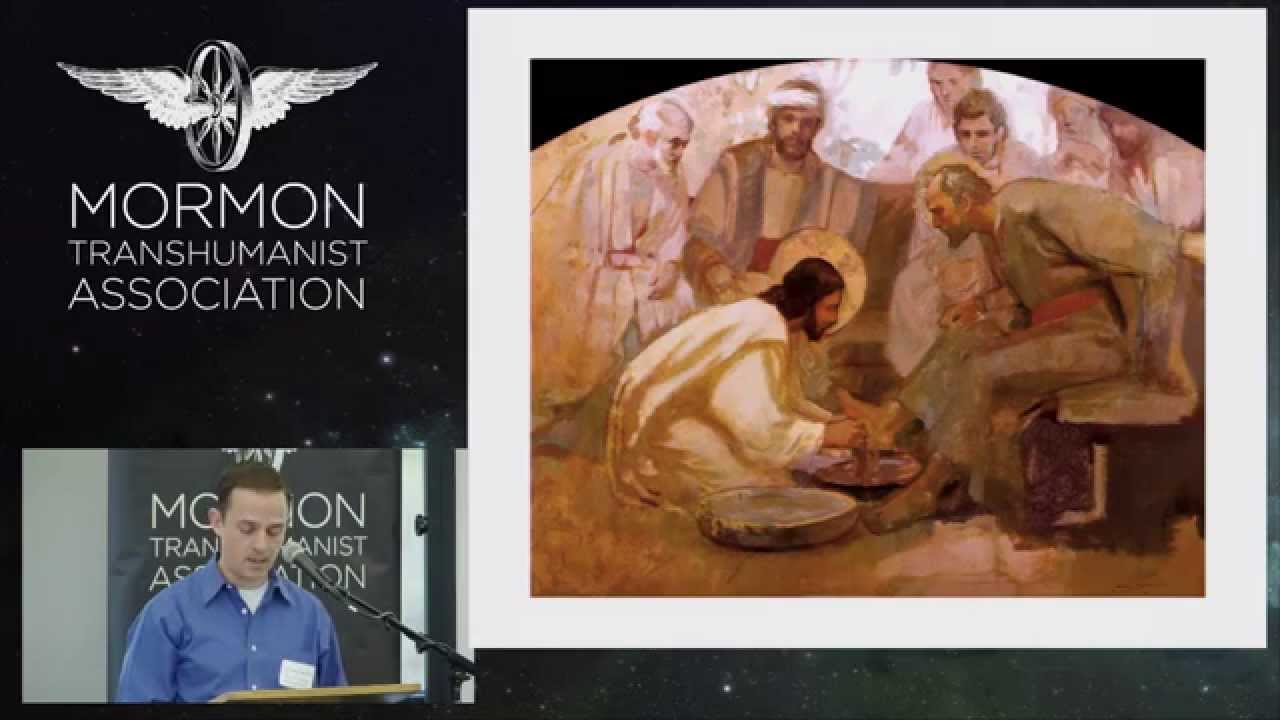
This was presented at MTAConf 2015

Read more →

Encountering God

The teenage Joseph Smith had an epiphany as he wrestled with scripture and the competing religious factions around him: answers to his questions were not to be found in an appeal to argumentation or to religious text; they were to be found in direct encounter with God. Thus began a prophetic career that attempted to facilitate and democratize communion with God.

Revelation begins where inherited answers give way to encounter.

Read more →

Questioning Assumption, Exploring the Soul

If you created ants, would you let them dream? Why or why not? What do you know or believe about your own dreams? Has that always been the case? When, if at all, did how you feel about your dreams change? What triggered the change? What was the best dream you ever had? Why is that? When do you dream? How is your dream life different than your waking life? Why do you think that is?

Even small minds open onto questions large enough to change the soul.

Read more →