Videos

Showing 221–230 of 276
An Atheist Transhumanist Critique of Religious Transhumanism
17:41

Peter Wicks

An Atheist Transhumanist Critique of Religious Transhumanism

Peter Wicks, a mathematician and policy researcher who describes himself as an atheist, offers a sympathetic but critical examination of religious transhumanism. While acknowledging that religious transhumanists can serve as valuable bridges to religious communities and as dissenting voices within the predominantly secular movement, he warns that religious language may lack the precision needed to navigate toward a transcendent future. Wicks identifies several “limiting beliefs” to avoid—including assumptions that faith must mean belief in God, that transcendent experiences require religious interpretation, and that aesthetics and emotion must be channeled through spirituality—and urges all transhumanists, religious or otherwise, to question even their most cherished beliefs.

Materialism, Free Will and Mormonism
20:31

Adam Davis

Materialism, Free Will and Mormonism

Adam Davis explores the tension between materialism and free will within a Latter-day Saint framework. He outlines the “basic argument” against free will—that we cannot be ultimately responsible for our actions unless we are the cause of ourselves—and suggests that Mormon theology offers a unique solution through the doctrine of uncreated, eternal intelligences. Davis argues that for intelligent matter to serve as the genuine source of agency, it must receive information simultaneously rather than sequentially, and he proposes that quantum superposition may provide the mechanism by which perception and memory can interface with an irreducible core of agency. He concludes that artificial intelligence, being created rather than uncreate, likely cannot achieve true free will.

A Mormon Perspective on Transhumanism
1:03:28

Carl Youngblood

A Mormon Perspective on Transhumanism

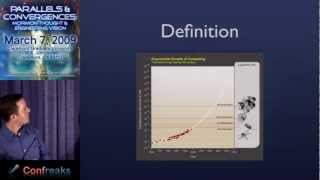
Carl Youngblood presents an introduction to Mormon transhumanism, drawing parallels between LDS doctrines and transhumanist concepts. He examines how Mormon teachings about the dispensation of the fullness of times, the millennium, immortality, and eternal progression align with transhumanist ideas about technological epochs, the singularity, and posthuman potential. Youngblood explains exponential growth through parables both ancient and modern, discusses how miracles may have natural explanations yet to be discovered, and explores the simulation argument’s theological implications. He concludes by reflecting on tensions between passive faith in future redemption and the active work transhumanism suggests we must undertake to achieve God’s purposes.

Afternoon Q&A with Carl Youngblood and Joseph West
3:28

Carl Youngblood

Afternoon Q&A with Carl Youngblood and Joseph West

This Q&A session addresses a variation of the Fermi paradox in light of Ray Kurzweil’s sixth epoch of evolution, in which the universe “wakes up” and becomes infused with intelligence. If an advanced civilization could theoretically awaken the universe, why is it not already awake? One panelist suggests that such awakening would proceed outward from wherever a civilization originated, potentially far from us, and is limited by the matter available in the universe. Another panelist offers a provocative alternative: perhaps advanced civilizations do communicate with us, but through means we struggle to verify—namely, the long history of humanity’s claimed contact with the divine. These experiences, dismissed by thinkers like Nick Bostrom, might actually constitute evidence of communication from advanced beings that we will only fully recognize when we ourselves become “neo-humans” or gods.

Transfiguration: Parallels and Complements between Mormonism and Transhumanism
28:15

Carl Youngblood

Transfiguration: Parallels and Complements between Mormonism and Transhumanism

Carl Youngblood draws striking parallels between Mormon theology and transhumanist thought, demonstrating how concepts like the “dispensation of the fullness of times” correspond to technological epochs, the millennium to the singularity, and the Mormon doctrine of becoming gods to transhumanist visions of posthumanity. He explains exponential growth through vivid examples—from rice on a chessboard to Moore’s Law—and argues that by 2045, a thousand dollars will buy computing power exceeding all human brains combined. Youngblood suggests that Mormonism can inform transhumanism with its emphasis on love and inclusive access to technology, while transhumanism can invigorate Mormon faith by providing rational foundations for doctrines of resurrection and immortality.