Opinion

95 Thoughts on April 2022 General Conference

Lincoln Cannon
Lincoln Cannon

Lincoln Cannon is an American philosopher and technologist who co-founded the Mormon Transhumanist Association in 2006, serving as its president from 2006 to 2016. He is a leading advocate of technological evolution and postsecular religion, combining software engineering expertise with degrees in philosophy and business. Cannon is also a founder and board member of the Christian Transhumanist Association. He formulated the New God Argument, a logical argument for faith in God that has become popular among religious transhumanists. His academic work includes “Mormonism Mandates Transhumanism” published in Religion and Human Enhancement: Death, Values, and Morality (Palgrave Macmillan, 2017) and “Transfigurism: A Future of Religion as Exemplified by Religious Transhumanists” published in The Transhumanism Handbook (Springer Verlag, 2019). Mormon transhumanism, as articulated by Cannon, holds that humanity should learn how to be compassionate creators. This idea is central to the Mormon theological tradition, which provides a religious framework consistent with naturalism and supportive of human transformation. Cannon’s work bridges religious faith with scientific advancement, advocating for the ethical use of technology to extend human abilities in ways consistent with a religious worldview.

Last Saturday and Sunday, members of The Church of Jesus Christ of Latter-day Saints, the largest Mormon denomination, gathered for our 192nd annual General Conference. It’s a long-standing tradition. Recently, it’s also become a tradition for some Church members to share our thoughts and interact with each other during the conference via Twitter. I often participate in that.

General Conference

Read more →

Wesley Smith Still Lies About Transhumanism

Lincoln Cannon
Lincoln Cannon

Lincoln Cannon is an American philosopher and technologist who co-founded the Mormon Transhumanist Association in 2006, serving as its president from 2006 to 2016. He is a leading advocate of technological evolution and postsecular religion, combining software engineering expertise with degrees in philosophy and business. Cannon is also a founder and board member of the Christian Transhumanist Association. He formulated the New God Argument, a logical argument for faith in God that has become popular among religious transhumanists. His academic work includes “Mormonism Mandates Transhumanism” published in Religion and Human Enhancement: Death, Values, and Morality (Palgrave Macmillan, 2017) and “Transfigurism: A Future of Religion as Exemplified by Religious Transhumanists” published in The Transhumanism Handbook (Springer Verlag, 2019). Mormon transhumanism, as articulated by Cannon, holds that humanity should learn how to be compassionate creators. This idea is central to the Mormon theological tradition, which provides a religious framework consistent with naturalism and supportive of human transformation. Cannon’s work bridges religious faith with scientific advancement, advocating for the ethical use of technology to extend human abilities in ways consistent with a religious worldview.

Faith with Action

Writing for the First Things website, Wesley Smith is talking about Transhumanism again. And again he appears not really to know what he’s talking about. But appearances can be deceiving. In this case, he does actually know what he’s talking about, at least enough to be dishonest.

I and others have attempted to correct Wesley’s mischaracterizations of Transhumanism multiple times in the past. But he continues to misrepresent Transhumanism. And he continues to misrepresent Christian Transhumanism. The pattern continues to entail lying.

Read more →

Decentralization of God

Lincoln Cannon
Lincoln Cannon

Lincoln Cannon is an American philosopher and technologist who co-founded the Mormon Transhumanist Association in 2006, serving as its president from 2006 to 2016. He is a leading advocate of technological evolution and postsecular religion, combining software engineering expertise with degrees in philosophy and business. Cannon is also a founder and board member of the Christian Transhumanist Association. He formulated the New God Argument, a logical argument for faith in God that has become popular among religious transhumanists. His academic work includes “Mormonism Mandates Transhumanism” published in Religion and Human Enhancement: Death, Values, and Morality (Palgrave Macmillan, 2017) and “Transfigurism: A Future of Religion as Exemplified by Religious Transhumanists” published in The Transhumanism Handbook (Springer Verlag, 2019). Mormon transhumanism, as articulated by Cannon, holds that humanity should learn how to be compassionate creators. This idea is central to the Mormon theological tradition, which provides a religious framework consistent with naturalism and supportive of human transformation. Cannon’s work bridges religious faith with scientific advancement, advocating for the ethical use of technology to extend human abilities in ways consistent with a religious worldview.

Sacrament of Decentralization

In the Apocalypse, we read that Christ offers us a crown, and invites us to sit together on the throne of God. We read that Christ would make us kings to God. These iron age signs and tokens of governance, Christ would decentralize. If we’re able to imagine that, we’re already on our way to decentralization of God.

Read more →

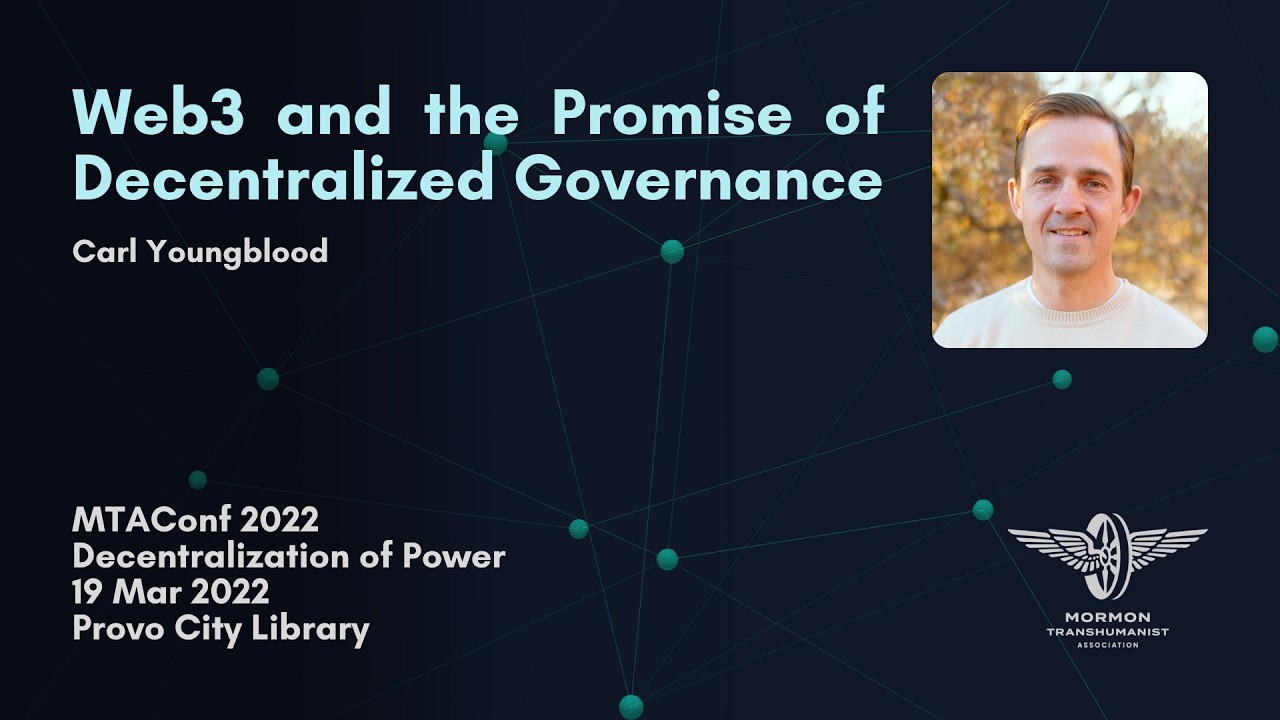
Web3 and the Promise of Decentralized Governance

Carl Youngblood
Carl Youngblood

Carl Youngblood co-founded the MTA in 2006 and has served as its President and CEO since 2021. He is engaged with the Association’s efforts to explore the intersection of Mormon theology and transhumanist philosophy. Among the many initiatives that Carl has been involved with, he has designed and built the Association’s current website, which unifies all prior content in a single location using inspiring visuals and animations. Youngblood’s professional career spans more than two decades of full-stack software development at the intersection of Silicon Slopes and Silicon Valley. He was an early employee at Omniture (acquired by Adobe), a founding engineering leader at Divvy (a Utah-based unicorn startup), co-founder of Blockscale LLC (a blockchain services firm eventually contracted into Coinbase), and Senior Solutions Architect for Amazon Managed Blockchain at AWS. His technical fluency ranges from scalable web architecture to blockchain infrastructure—the kind of deep engineering experience that grounds his theological speculation in working knowledge of the systems he writes about. Under his leadership, the Association has developed its mission of promoting abundant human flourishing through the compassionate use of science and technology, fostering dialogue across secular and religious audiences and arguing that each has something essential to learn from the other. His writing, collected on his blog From the Depths, spans over a decade of conference presentations and theological essays: meditations on participatory resurrection, the alignment of artificial intelligence read through the Grand Council narrative, intelligence as eternal and multifaceted, and religion as social technology. He writes, as a colleague has observed, with warmth and accessibility on questions of momentous practical consequence—how to navigate faith crisis without losing faith’s power, how to think about resurrection as something we actively participate in rather than passively receive. Youngblood’s distinctive contribution to transhumanism is the integration of serious technical expertise with serious theological reflection. He embodies the Mormon transhumanist conviction that scientific and spiritual development are not parallel tracks but a single path—that the learning required to build better systems is continuous with the exaltation Mormon theology envisions, and that human ingenuity, rightly oriented, is itself a divine imperative.

This essay was presented at MTAConf 2022: Decentralization of Power

Read more →

A Bluish-Green Pebble

Lincoln Cannon
Lincoln Cannon

Lincoln Cannon is an American philosopher and technologist who co-founded the Mormon Transhumanist Association in 2006, serving as its president from 2006 to 2016. He is a leading advocate of technological evolution and postsecular religion, combining software engineering expertise with degrees in philosophy and business. Cannon is also a founder and board member of the Christian Transhumanist Association. He formulated the New God Argument, a logical argument for faith in God that has become popular among religious transhumanists. His academic work includes “Mormonism Mandates Transhumanism” published in Religion and Human Enhancement: Death, Values, and Morality (Palgrave Macmillan, 2017) and “Transfigurism: A Future of Religion as Exemplified by Religious Transhumanists” published in The Transhumanism Handbook (Springer Verlag, 2019). Mormon transhumanism, as articulated by Cannon, holds that humanity should learn how to be compassionate creators. This idea is central to the Mormon theological tradition, which provides a religious framework consistent with naturalism and supportive of human transformation. Cannon’s work bridges religious faith with scientific advancement, advocating for the ethical use of technology to extend human abilities in ways consistent with a religious worldview.

Bluish-Green Pebble

This is a poem that I wrote for and gifted to my father, while he was still alive. He died from his third cancer in 1998. The color of the pebble is a reference both to my father’s eyes and to the Earth.

A bluish-green pebble
bemoaning its being,
and wondering whether
‘twas doing its Doings,
regarded the heavens
and prayed with what power
a bluish-green pebble
may manage to muster.

Read more →

Covenant Is Atonement

Lincoln Cannon
Lincoln Cannon

Lincoln Cannon is an American philosopher and technologist who co-founded the Mormon Transhumanist Association in 2006, serving as its president from 2006 to 2016. He is a leading advocate of technological evolution and postsecular religion, combining software engineering expertise with degrees in philosophy and business. Cannon is also a founder and board member of the Christian Transhumanist Association. He formulated the New God Argument, a logical argument for faith in God that has become popular among religious transhumanists. His academic work includes “Mormonism Mandates Transhumanism” published in Religion and Human Enhancement: Death, Values, and Morality (Palgrave Macmillan, 2017) and “Transfigurism: A Future of Religion as Exemplified by Religious Transhumanists” published in The Transhumanism Handbook (Springer Verlag, 2019). Mormon transhumanism, as articulated by Cannon, holds that humanity should learn how to be compassionate creators. This idea is central to the Mormon theological tradition, which provides a religious framework consistent with naturalism and supportive of human transformation. Cannon’s work bridges religious faith with scientific advancement, advocating for the ethical use of technology to extend human abilities in ways consistent with a religious worldview.

Atonement

This is a transcript of a talk that I gave to my ward, my local congregation of The Church of Jesus Christ of Latter-day Saints, earlier today. Ward leaders asked me to talk about making and keeping covenants. So I’ve been thinking and praying about the topic. And I hope my comments will also be helpful for you.

Of course, the topic of covenants is always relevant at Church. But, to me, the topic seems particularly relevant now, given the challenges that we’re all facing.

Read more →

The Economy of Godhood

Lincoln Cannon
Lincoln Cannon

Lincoln Cannon is an American philosopher and technologist who co-founded the Mormon Transhumanist Association in 2006, serving as its president from 2006 to 2016. He is a leading advocate of technological evolution and postsecular religion, combining software engineering expertise with degrees in philosophy and business. Cannon is also a founder and board member of the Christian Transhumanist Association. He formulated the New God Argument, a logical argument for faith in God that has become popular among religious transhumanists. His academic work includes “Mormonism Mandates Transhumanism” published in Religion and Human Enhancement: Death, Values, and Morality (Palgrave Macmillan, 2017) and “Transfigurism: A Future of Religion as Exemplified by Religious Transhumanists” published in The Transhumanism Handbook (Springer Verlag, 2019). Mormon transhumanism, as articulated by Cannon, holds that humanity should learn how to be compassionate creators. This idea is central to the Mormon theological tradition, which provides a religious framework consistent with naturalism and supportive of human transformation. Cannon’s work bridges religious faith with scientific advancement, advocating for the ethical use of technology to extend human abilities in ways consistent with a religious worldview.

Godhood is the ultimate conceptualization of power. From many Gods through one God, human minds evolved. We knew many. We knew one. Now the apocalypse is here: whether there’s one God or many Gods, all are being revealed. And as they appear, we are seeing that we are like them.

For theosis, it will never be enough simply to think or pray or even love harder⁠—unless “harder” implies concrete application of knowledge via the technology of the day. Mysticism and righteousness in themselves won’t be enough. Faith without works has always been dead.

Read more →

As We, in Turn, Become the Limits of Humanity

Lincoln Cannon
Lincoln Cannon

Lincoln Cannon is an American philosopher and technologist who co-founded the Mormon Transhumanist Association in 2006, serving as its president from 2006 to 2016. He is a leading advocate of technological evolution and postsecular religion, combining software engineering expertise with degrees in philosophy and business. Cannon is also a founder and board member of the Christian Transhumanist Association. He formulated the New God Argument, a logical argument for faith in God that has become popular among religious transhumanists. His academic work includes “Mormonism Mandates Transhumanism” published in Religion and Human Enhancement: Death, Values, and Morality (Palgrave Macmillan, 2017) and “Transfigurism: A Future of Religion as Exemplified by Religious Transhumanists” published in The Transhumanism Handbook (Springer Verlag, 2019). Mormon transhumanism, as articulated by Cannon, holds that humanity should learn how to be compassionate creators. This idea is central to the Mormon theological tradition, which provides a religious framework consistent with naturalism and supportive of human transformation. Cannon’s work bridges religious faith with scientific advancement, advocating for the ethical use of technology to extend human abilities in ways consistent with a religious worldview.

Our living ancestors are shelter from the limits of humanity. Within their walls, much is well lit. Much is visible. Much is familiar.

But there’s an outside. Beyond their lives, none of us has yet ventured. But we know it’s there, if “there” is the right word to describe it. It’s at least “there” relative to us.

We tell each other stories about light and darkness beyond. Some of us know, justifiably or not, rightly or wrongly, that some of our stories are true. Some of us hope so. Some of us fear so.

Read more →

The Apotheosis of Pity

Lincoln Cannon
Lincoln Cannon

Lincoln Cannon is an American philosopher and technologist who co-founded the Mormon Transhumanist Association in 2006, serving as its president from 2006 to 2016. He is a leading advocate of technological evolution and postsecular religion, combining software engineering expertise with degrees in philosophy and business. Cannon is also a founder and board member of the Christian Transhumanist Association. He formulated the New God Argument, a logical argument for faith in God that has become popular among religious transhumanists. His academic work includes “Mormonism Mandates Transhumanism” published in Religion and Human Enhancement: Death, Values, and Morality (Palgrave Macmillan, 2017) and “Transfigurism: A Future of Religion as Exemplified by Religious Transhumanists” published in The Transhumanism Handbook (Springer Verlag, 2019). Mormon transhumanism, as articulated by Cannon, holds that humanity should learn how to be compassionate creators. This idea is central to the Mormon theological tradition, which provides a religious framework consistent with naturalism and supportive of human transformation. Cannon’s work bridges religious faith with scientific advancement, advocating for the ethical use of technology to extend human abilities in ways consistent with a religious worldview.

The Apotheosis of Pity

Pulled from the crowd into the light, I stumbled blindly. But my friends supported me by both arms. They guided me some distance, whispering comfort to my ears. And they lowered me carefully to the ground.

As soon as they had released my left arm and before I could thank them, some of my friends turned and rushed away. “We will avenge you!”

With eyes adjusting to the light, I finally saw them. Bold and beautiful, the avengers leapt high on the crowd. Exerting an almost superhuman effort, they pushed, pulled, and climbed.

Read more →

NFT Memorial to Mormon Transhumanist Leaders

Lincoln Cannon
Lincoln Cannon

Lincoln Cannon is an American philosopher and technologist who co-founded the Mormon Transhumanist Association in 2006, serving as its president from 2006 to 2016. He is a leading advocate of technological evolution and postsecular religion, combining software engineering expertise with degrees in philosophy and business. Cannon is also a founder and board member of the Christian Transhumanist Association. He formulated the New God Argument, a logical argument for faith in God that has become popular among religious transhumanists. His academic work includes “Mormonism Mandates Transhumanism” published in Religion and Human Enhancement: Death, Values, and Morality (Palgrave Macmillan, 2017) and “Transfigurism: A Future of Religion as Exemplified by Religious Transhumanists” published in The Transhumanism Handbook (Springer Verlag, 2019). Mormon transhumanism, as articulated by Cannon, holds that humanity should learn how to be compassionate creators. This idea is central to the Mormon theological tradition, which provides a religious framework consistent with naturalism and supportive of human transformation. Cannon’s work bridges religious faith with scientific advancement, advocating for the ethical use of technology to extend human abilities in ways consistent with a religious worldview.

The Computation of Humanity

In April of this year, I completed my fifth and final term as a board member of the Mormon Transhumanist Association. During those fifteen years, it was my privilege and pleasure to share in service on the board with 24 of the finest people that I know personally:

  • Andrew West
  • Ben Blair
  • Blaire Ostler
  • Brad Carmack
  • Brent Allsop
  • Bryant Smith
  • Caleb Jones
  • Carl Youngblood
  • Christopher Bradford
  • Connie Packer
  • Cory Funk
  • David Foster
  • Don Bradley
  • Dorothy Deasy
  • James Carroll
  • Jon Ogden
  • Joseph West
  • Karl Hale
  • Leonard Reil
  • Marcus Flinders
  • Michael Ferguson
  • Nathan Hadfield
  • Pace Ellsworth
  • Wendy Smith
Read more →