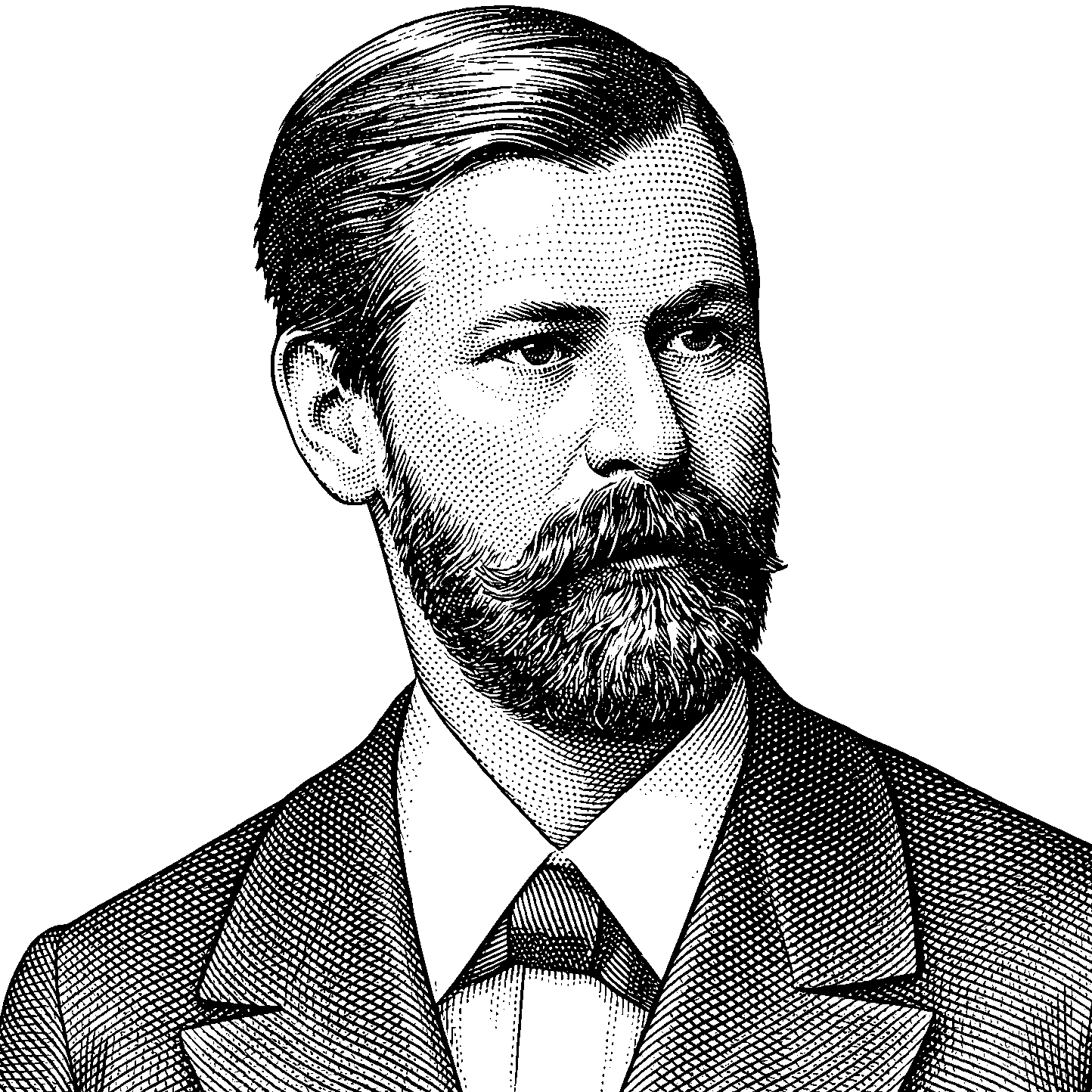
Sigmund Freud
1856 – 1939
Sigmund Freud (1856–1939) was an Austrian neurologist and the founder of psychoanalysis, a clinical method for treating psychopathology through dialogue between patient and analyst. His theories about the unconscious mind, defense mechanisms, and the structure of personality revolutionized the understanding of human psychology and influenced fields ranging from psychiatry to literature, art, and philosophy. Though many of his specific theories have been superseded, his broader insight—that unconscious forces shape human thought and behavior—remains foundational.
Born in Freiberg, Moravia (now Příbor, Czech Republic), to Jewish parents, Freud moved with his family to Vienna at age four. He excelled academically and entered the University of Vienna medical school in 1873, eventually specializing in neurology. After studying with Jean-Martin Charcot in Paris, where he observed the use of hypnosis to treat hysteria, Freud began developing his own therapeutic techniques centered on free association and the interpretation of dreams.
Freud’s landmark work The Interpretation of Dreams (1899) argued that dreams provide access to the unconscious mind and its repressed desires. He went on to develop a comprehensive theory of psychic structure, dividing the mind into id (primitive desires), ego (rational self), and superego (internalized moral standards). His theories of psychosexual development and the Oedipus complex, while controversial, opened new avenues for understanding childhood experience and its lasting effects.
In later works such as Civilization and Its Discontents (1930), Freud explored the tension between individual drives and the demands of civilization. He suggested that human progress requires the sublimation of instinctual energies into socially constructive activities. While pessimistic about humanity’s prospects for happiness, Freud nonetheless believed that rational self-understanding could mitigate neurotic suffering and enable more authentic living.
In 1938, following the Nazi annexation of Austria, Freud fled to London, where he died of cancer the following year. His legacy for transhumanist thought is ambivalent. On one hand, Freud emphasized the limitations imposed by unconscious forces and the difficulty of achieving genuine self-mastery. On the other hand, his project of bringing unconscious processes to conscious awareness—encapsulated in his maxim ‘Where id was, there ego shall be’—represents an early vision of using knowledge to enhance human autonomy and self-determination.