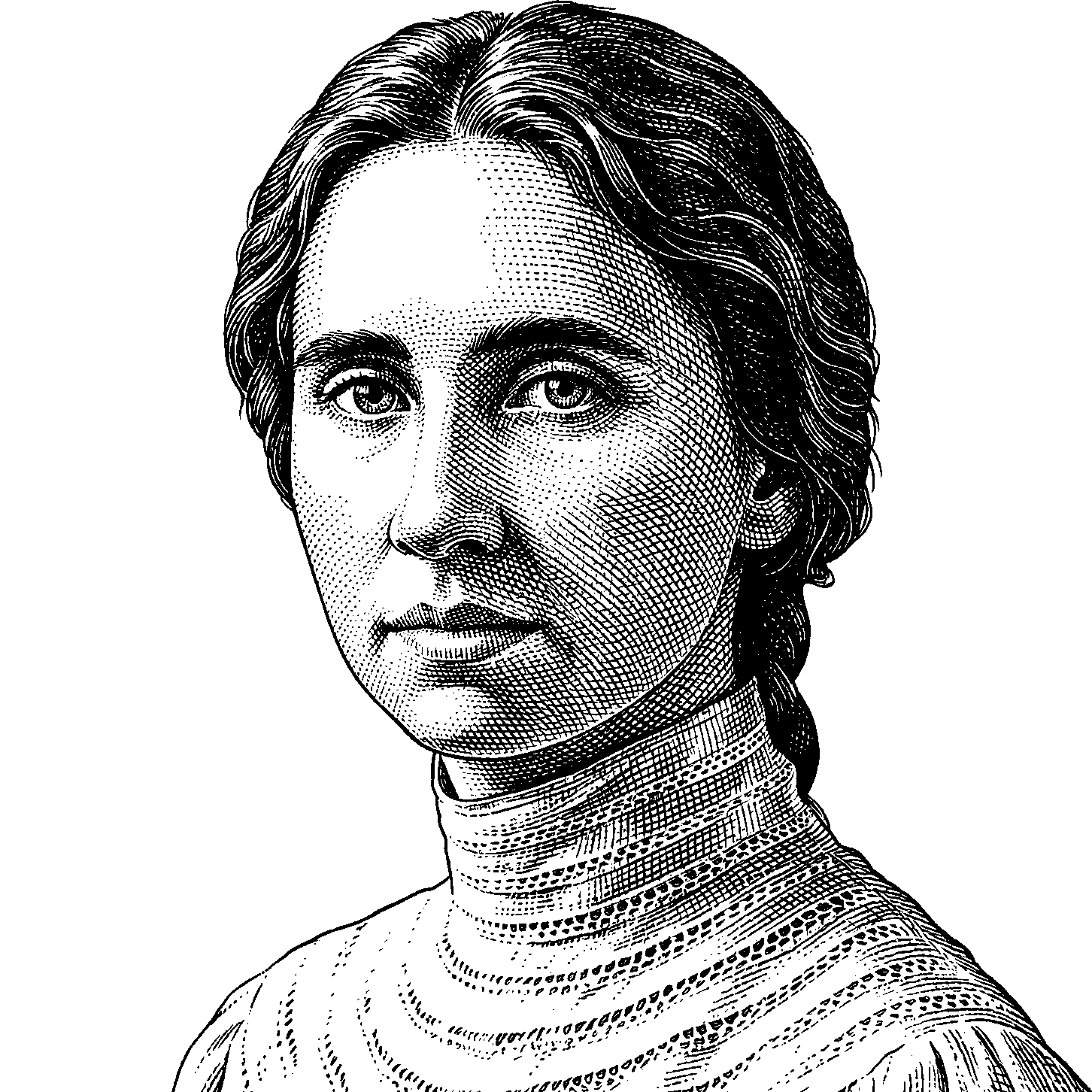
Helen Keller
1880 – 1968
Helen Adams Keller (1880–1968) was an American author, disability rights advocate, political activist, and lecturer who became one of the most celebrated figures of the twentieth century. The first deafblind person to earn a Bachelor of Arts degree, Keller’s life demonstrated the extraordinary capacity of the human spirit to transcend seemingly insurmountable limitations.
Born in Tuscumbia, Alabama, Keller lost both her sight and hearing at nineteen months of age due to an illness—likely scarlet fever or meningitis. For the next five years, she lived in an isolated world, able to communicate only through crude gestures. Her life transformed in 1887 when Anne Sullivan, a partially blind teacher from the Perkins School for the Blind, arrived as her instructor. Sullivan’s breakthrough came when she spelled ‘w-a-t-e-r’ into Keller’s hand while pumping water over it—a moment that awakened Keller to the power of language and opened her world to understanding.
Under Sullivan’s guidance, Keller learned to read, write, and eventually speak. She attended the Perkins School for the Blind and later the Cambridge School for Young Ladies. In 1904, she graduated cum laude from Radcliffe College, becoming the first deafblind person to earn a bachelor’s degree. Her education was supported in part by Mark Twain, who introduced her to Standard Oil magnate Henry Huttleston Rogers.
Keller became a prolific author, publishing twelve books and numerous articles. Her autobiography, The Story of My Life (1903), written while she was still a student, became an international bestseller translated into fifty languages. She was also a committed political activist, advocating for women’s suffrage, labor rights, and socialism. She helped found the American Civil Liberties Union (ACLU) and worked tirelessly for the American Foundation for the Blind from 1924 until her death.
Keller’s legacy extends far beyond her personal achievements. She met every U.S. president from Grover Cleveland to Lyndon B. Johnson and was awarded the Presidential Medal of Freedom by President Johnson in 1964. Her life embodies themes central to transhumanist thought: the enhancement of human capabilities through technology and education, the transcendence of biological limitations, and the relentless pursuit of human flourishing. She famously wrote, “Alone we can do so little; together we can do so much,” reflecting her belief in collective human progress and the power of compassion to transform society.