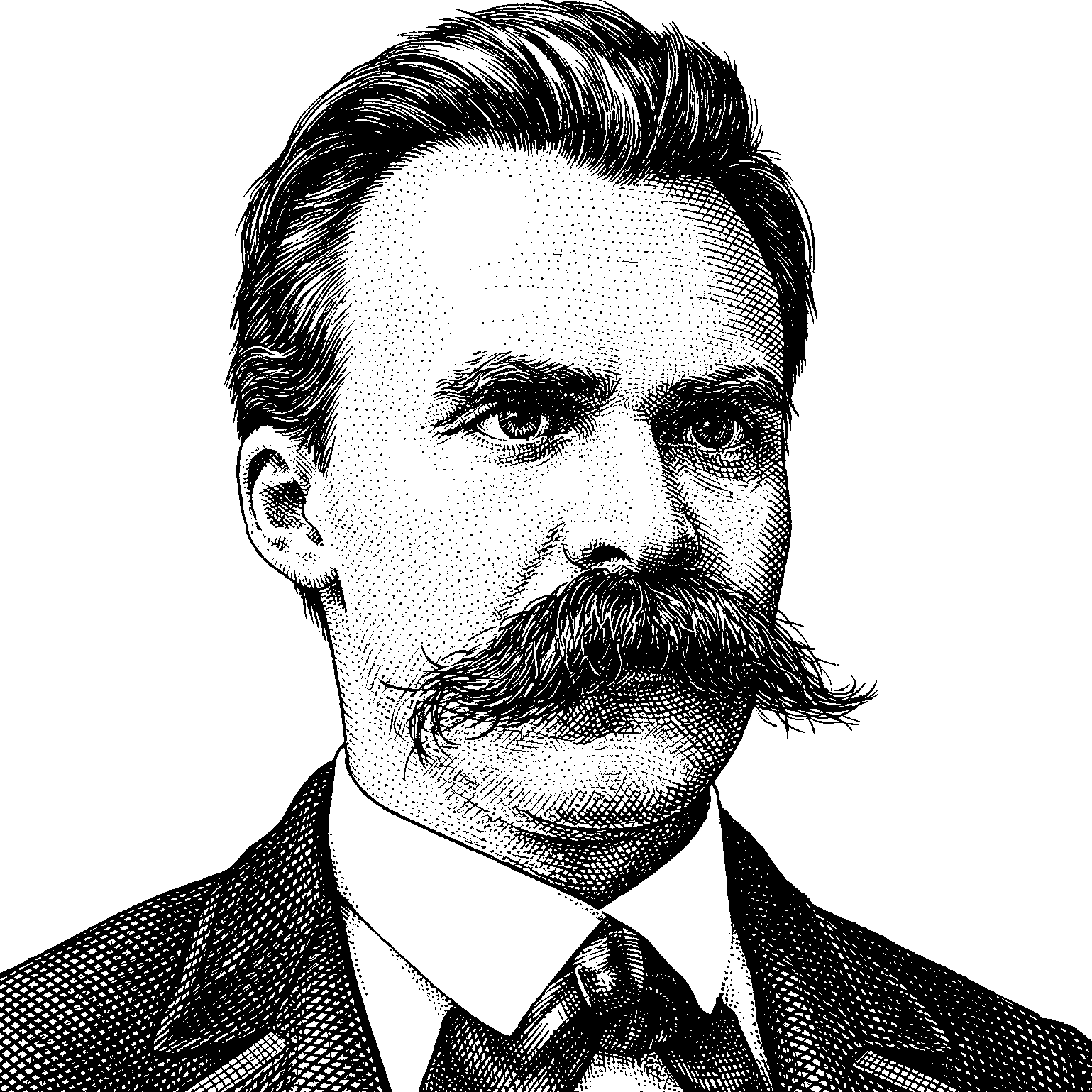
Friedrich Wilhelm Nietzsche (1844–1900) was a German philosopher, cultural critic, and philologist whose provocative ideas about morality, religion, and human potential have profoundly influenced modern thought. His concept of the ‘Übermensch’ (often translated as ‘overman’ or ‘superman’) and his call for humanity to transcend conventional values have made him a touchstone for transhumanist philosophy, even as his ideas remain subject to intense debate and varying interpretations.
Born in Röcken, Prussia, Nietzsche was the son of a Lutheran pastor who died when Friedrich was four years old. He showed exceptional academic ability and became a professor of classical philology at the University of Basel at the remarkably young age of twenty-four. However, chronic illness forced his retirement from teaching in 1879, after which he spent the next decade as an independent philosopher, living modestly in boarding houses across Switzerland, Italy, and France while producing his most important works.
Nietzsche’s major works—including Thus Spoke Zarathustra, Beyond Good and Evil, On the Genealogy of Morality, and The Gay Science—challenged the foundations of Western morality and religion. He famously proclaimed that ‘God is dead,’ not as a celebration but as a diagnosis of modern culture’s loss of transcendent meaning. His response was to call for a ‘revaluation of all values’ and the emergence of individuals who could create new meaning through the exercise of will.
The concept of the Übermensch represents Nietzsche’s vision of human potential. Rather than a biological superman, Nietzsche envisioned a human being who had overcome the limitations of conventional morality to create new values and embrace life fully. This figure would say ‘yes’ to existence, including its suffering, through what Nietzsche called amor fati—love of fate. The Übermensch was to be the meaning of the earth, replacing otherworldly hopes with earthly creativity and self-overcoming.
In 1889, Nietzsche suffered a mental collapse from which he never recovered, spending his final years in the care of his mother and sister. Despite the tragic end of his productive life, his influence only grew after his death. Transhumanists have drawn on his vision of human self-transcendence, though they typically emphasize technological means of enhancement that Nietzsche himself never contemplated. His insistence that humanity is ‘something to be overcome’ and his rejection of static human nature resonate with contemporary projects aimed at expanding human capabilities.